Sarah Philipson · 2026
From Human Knowing and Other Writings. Download the complete ebook, including notes.Prompting for reorganizing tacit Knowing: Epistemic practice in human-AI interaction
Previously published in Computers in Human Behavior: Artifical Humans Online publication: 10 September 2026 Volume 10 (2026), article 2949-8821
100399, DOI: 10.1016/j.chbah.2026.100399. Slightly revised.
Prompting has rapidly become a central practice in human–AI interaction, yet it is often treated primarily as a technical procedure for controlling generative models. This article develops a sociomaterial epistemology of prompting in organizational and professional knowledge work, arguing that prompting can constitute an epistemic practice grounded in the partial externalization of tacit knowing. Drawing on Polanyi, Vygotskian mediation, sketch theory, distributed cognition, and boundary-object theory, the article conceptualizes prompting as a recursive process in which a user partially externalizes tacit knowing in a prompt, encounters LLM-generated linguistic variation, and interprets that material against existing understanding. Elements of the generated response may be resisted, appropriated, or partially internalized, thereby contributing to the reorganization of the tacit ground from which subsequent articulation emerges.
This account differs from conversion-based epistemologies such as SECI: tacit knowing is not treated as content that can be transformed into explicit knowledge, but as a mode of attending that can only be partially articulated.
Epistemic agency therefore remains human; the LLM contributes patterned linguistic variation that changes the material available for interpretation without itself knowing or interpreting. The article distinguishes three types of prompting within this recursive process: thinking prompts support individual exploration and partial externalization; talking prompts introduce socially distributed interpretation and negotiation across different tacit repertoires; and prescriptive prompts represent provisionally stabilized articulations that may circulate beyond the community in which their meaning was negotiated. The framework shows how prompting can reorganize tacit knowing while also enabling provisional stabilization and coordination in organizational knowledge work.
Keywords: Prompting, Tacit knowing, Partial externalization, Socio-materiality, Boundary objects, Polanyi, Vygotsky, Generative AI, Knowledge practices
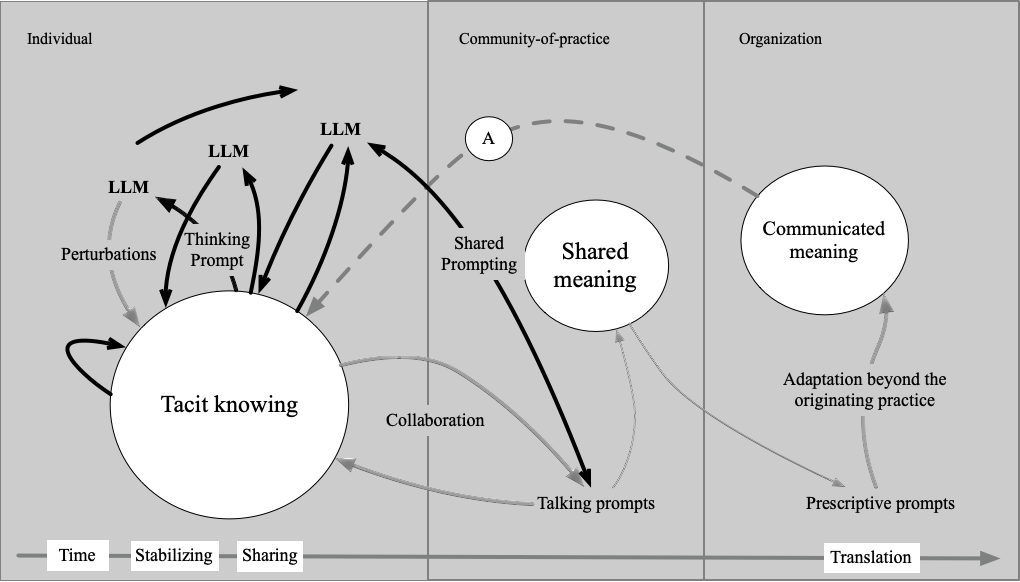
The rapid integration of large language models into organizational knowledge work raises a fundamental question that extends beyond technical performance: how does AI-mediated interaction reshape the processes through which organizational actors create, develop, and negotiate knowledge? (see Fig. 1)
Existing research has largely focused on prompt engineering, model capabilities, or human–AI collaboration, while giving comparatively little attention to prompting as part of an epistemic process of mediated knowledge creation. While research has long recognized the tacit, social, and materially mediated dimensions of knowing, these dimensions are often addressed in isolation. Studies of tacit knowing emphasize embodied skill and personal judgment; sociocultural perspectives highlight discourse, mediation, and participation; and organizational research examines how tools, artifacts, and institutional arrangements structure epistemic work. What remains underdeveloped is an integrative framework explaining how these dimensions interact when AI systems become embedded in knowledge-creation practices.
This article develops an epistemology of prompting, arguing that prompting is best understood as a recursive practice of partial tacit externalization, through which organizational actors reorganize knowing in interaction with LLMs and communities of practice. Although the argument is grounded in generative-AI interaction, its contribution is theoretical: it articulates how tacit knowing is partially externalized, reorganized, and stabilized through mediated interaction, with artifacts. Prompting provides a particularly transparent case of these epistemic dynamics, making visible processes that are often implicit in other forms of knowledge work.
The proliferation of generative AI has intensified attention to prompting, commonly approached as a technical skill for formulating instructions that elicit effective outputs from probabilistic language models.46 Prompting competence is consequently often framed in procedural terms, as the ability to formulate effective instructions or prompts (Koutsiana et al., 202447; Sun & Kalar, 202548).
Three central claims structure the argument. First, externalization is necessarily partial: “There are things that we know but cannot tell” (Polanyi, 1962, p. 601), because the subsidiary grounds of tacit knowing may be unspecifiable and tacit integration is irreducible (Polanyi, 1968, pp. 30-32). This position is incompatible with conversion-based epistemologies, such as Nonaka's SECI model (Nonaka, 1991, 1994; Nonaka & Takeuchi, 1995; Nonaka et al., 2000). Second, talking prompts can function as focal points for discourse within communities of practice, where differences among tacit repertoires become visible, negotiable, and collectively interpreted. Third, AI-generated variation can enable users to notice distinctive elements of their own tacit knowing that were not previously in focal awareness, without attributing epistemic agency to the AI system.
Such interpretations fundamentally misrepresent the epistemic character of prompting. Prompting is not merely an engineering technique; it can constitute an epistemic practice rooted in the partial externalization of tacit knowing. When formulating a prompt, users articulate fragments of the tacit structure guiding their interpretation, framing, and judgment. These externalizations are necessarily incomplete, and their articulation may itself reconfigure the underlying tacit knowing. The LLM then generates linguistic variation that may support, contradict, distort, or extend the user's partial externalization. Through
interpretation, elements of this generated material may be resisted, appropriated, or partially internalized, thereby reorganizing the tacit ground from which subsequent articulation emerges.
Beyond the skill development, the integration of generative AI into organizational settings is reshaping the distribution of cognitive labor, as workers increasingly verify outputs, reconcile conflicting responses, integrate AI-generated material, and judge when assistance is appropriate49 (Lee et al., 2025).
These practices relocate effort from execution to oversight, demanding new forms of interpretive, evaluative, and sensemaking work. Field studies in scientific and technical settings similarly document how generative AI tools function as workflow agents that must be steered, monitored, and corrected, requiring users to develop localized expertise in how these systems behave within their domains (Wagman et al., 2025). Together, these findings indicate that the organizational uptake of generative AI is not merely a matter of automation but the emergence of new epistemic responsibilities and supervisory competencies.
We develop three types within a recursive epistemic process of prompting – thinking, talking, and prescriptive prompts – and show how they operate under different individual and socially shared conditions. Across these types, prompting may contribute to the reorganization of tacit knowing and, in socially shared settings, to the provisional stabilization and circulation of articulations within epistemic and organizational contexts.

Fig. 1. Collaborative processes through which tacit knowing becomes partially externalized in practice, own.
This article situates prompting within socio-material traditions (Orlikowski, 2007) that examine how knowledge emerges from the interplay of human cognition, artifacts, and practice.50 Tacit knowing (Polanyi, 1962, 1966, 1968), Vygotskian mediation (1970-1999), sketch theory (Ferguson, 1992; Van der Lugt, 2005), distributed cognition (Hutchins, 2012)51, and boundary-object theory (Star, 2010; Star & Griesemer, 1989) collectively provide a foundation for understanding prompting as epistemic labor, rather than technical procedure. It also resonates with approaches to’ organizational learning (Feldman & Orlikowski, 2011; Lave & Wenger, 1991; Wenger, 1998, 2000; Wenger & Snyder, 2000), where knowledge emerges through mediated interaction.
The article proceeds by developing the theoretical foundation for this reconceptualization, presenting a model for prompting as epistemic reflection and externalization, and discussing implications for organizational learning, AI practice, and knowledge creation.
Three contributions sharpen this reframing. First, thinking prompts help users reflect on and begin to externalize tacit knowing. Second, talking prompts introduce a social dimension in which different tacit repertoires may make misalignment visible, interpretable, and negotiable. Third, prescriptive prompts represent partially stabilized articulations of negotiated meaning, providing a temporary fixation that can be circulated beyond the community of practice in which that meaning was negotiated.
This account does not claim that all prompting is epistemic. Rather, it argues that the distinctive human contribution to prompting is epistemic, regardless of the model's technical processes.
Recent knowledge-management research continues to frame GenAI through tacit–explicit conversion and SECI (He & Burger-Helmchen, 2024). Some of the phenomena described by He et al. (2026) – including sensemaking, tentative articulation, movement toward a more coherent conceptual core, and later social exposure – have antecedents (Philipson, & Kjellstrōm, 2020).
The contribution of the present paper therefore lies not simply in identifying these activities, but in theorizing the recursive mechanism through which partial externalization, LLM-generated response, human interpretation, and possible partial internalization reorganize tacit knowing. This account also differs epistemologically from He et al. (2026). Rather than treating GenAI as an epistemic interlocutor or potential site of knowledge creation, it locates epistemic agency in the human knower: the LLM generates linguistic variation, while interpretation, evaluation, partial internalization, and reorganization remain human processes. Externalization is therefore understood not as conversion of tacit knowing into explicit knowledge, but as partial articulation within a recursive process52 that may reorganize the tacit ground from which subsequent articulation emerges.
This chapter develops the Polanyian epistemological foundation for the argument. Its purpose is to clarify the tacit structure of knowing, and to distinguish tacit knowing from explicit, propositional knowledge. The discussion focuses on Polanyi, because his epistemology foregrounds the subsidiary – focal dynamics through which tacit knowing shapes perception and action. This provides the conceptual basis for understanding why prompting must be theorized as mediated externalization, rather than as a process of informational transfer.
2.1. Polanyian epistemology as foundation
Tacit knowing is the precondition of all knowing (Polanyi, 1966). It arises from the totality of an individual's experiences in diverse contexts and, accordingly, reflects both their diversity and their limits. Polanyi's theory provides the epistemological foundation for this argument.
Tacit knowing is not unarticulated content awaiting conversion, but a mode of attending: a structure of subsidiaries that supports focal awareness. From a Polanyian perspective, certain epistemological assumptions in Nonaka's SECI model appear problematic, particularly the treatment of tacit knowing as an articulable content awaiting conversion. SECI assumes that tacit and explicit knowledge are two forms of content, convertible through dialogue, metaphor, combination, and internalization. Tacit knowing is depicted as ineffable content awaiting articulation.The often-quoted statement that “we can know more than we can tell” is frequently taken to imply that tacit knowledge merely lacks articulation. Polanyi's claim is more radical: tacit subsidiaries cannot be fully inspected without transforming the knowing they support. Treating tacit and explicit dimensions as interdependent does not imply that tacit knowing can be converted into explicit knowledge. Rather, degrees of articulation are possible, while every articulation remains grounded in tacit knowing that it does not exhaust. Explicit knowledge is not a direct transformation of tacit knowing, but a symbolically reduced distillation of a far richer tacit structure.
Tacit knowing:
These properties render conception of “conversion” between tacit and explicit knowledge epistemologically untenable (Philipson, 2019; Gourlay, 2002, 2006; Grant, 2007; Gourlay & Nurse, 2005).
2.2. Why externalization is both necessary and constrained
While this article adopts a Polanyian foundation, it does not assume a strict dichotomy between tacit and explicit knowledge. As argued in more recent critiques (Amin & Roberts, 2008; Gourlay, 2006), tacit and explicit dimensions are interdependent and mutually shaping. Externalization is therefore not a “conversion”, but a process through which tacit knowing is partially reorganized and symbolically expressed through artifacts. This position acknowledges the interdependency of tacit and explicit dimensions, while retaining Polanyi's insight that tacit knowing remains the primary grounding of all meaningful action. Tacit knowing can be accessed – but not fully captured – through externalization, by creating artifacts that objectify portions of one's tacit structure (Philipson and Kjellstrōm, 2020).
Externalizations include diagrams, gestures, metaphors, sketches, and, crucially for our argument, prompts. Formulating a prompt requires the user to select what is relevant, impose distinctions, choose terminology, specify relations and constraints, and leave other aspects unstated. These acts draw upon the user's tacit knowing but do not reproduce it. The resulting prompt is therefore an explicit artifact of partial externalization, whose formulation remains grounded in tacit knowing. Prompting techniques and prompt artifacts can accordingly be made explicit, taught, standardized, and transferred; what remains tacit is not the prompt itself, but the knowing through which a user formulates, interprets, adapts, and evaluates it. Van der Lugt (2005) shows that early sketches externalize ambiguous, partly tacit intuitions, enabling designers to access and refine cognitive content inaccessible in purely mental form. As sketches are iteratively elaborated and interpreted, they evolve into shared artifacts that coordinate collaborative thinking (Ferguson, 1992). This closely mirrors the different epistemic roles prompts may assume, from exploratory externalizations to provisionally stabilized representations capable of supporting coordinated action.
Externalization:
Different traditions conceptualize the tacit–explicit relation differently. Conversion-oriented accounts treat tacit and explicit knowledge as distinguishable forms between which movement is possible, while practice-based and Polanyian accounts emphasize knowing as embodied, situated, and only partially articulable. The present article adopts the latter position because its theoretical problem concerns what happens when a user attempts to articulate knowing that cannot be exhaustively represented and then encounters generated material that may reorganize that knowing.
This has direct implications for prompting. When users articulate a prompt, they objectify fragments of subsidiary awareness. This objectification is transformative: shifting attention reorganizes tacit structure itself. Externalization is therefore not conversion from tacit to explicit knowledge, but the production of artifacts that reconfigure tacit knowing.
Understanding prompting requires abandoning conversion-based models of knowledge and recognizing externalization as an iterative, mediated reorganization of tacit knowing.
Building on the Polanyian framework outlined in Chapter 2, this chapter examines the implications of understanding tacit knowing as a mode of attending, rather than as latent content. If externalization is always partial, transformative, and sociomaterial, then models premised on conversion from tacit to explicit knowledge become problematic. Within this context, the limitations of SECI become visible.
Nonaka's SECI model (Nonaka, 1991, 1994; Nonaka & Takeuchi, 1995; Nonaka et al., 2000) remains influential in organizational knowledge creation, but is grounded in an epistemology incompatible with Polanyi. From a Polanyian perspective, certain epistemological assumptions in Nonaka's SECI model appear problematic, particularly the treatment of tacit knowing as an articulable content awaiting conversion. SECI assumes that tacit and explicit knowledge are two forms of content, convertible through dialogue, metaphor, combination, and internalization. Tacit knowing is depicted as ineffable content awaiting articulation. From a Polanyian perspective, this is a category mistake. Tacit knowing is not content; it is a mode of attending. Attempts to articulate it do not extract tacit knowing but transform it. SECI's notion of “externalization” presumes that tacit knowing can be made explicit without altering it, whereas Polanyi shows that articulation necessarily reorganizes subsidiaries.
Prompting makes this misalignment visible. Users struggle to stabilize instructions, because each attempt to specify tacit knowing changes what is being articulated. Misalignment and revision are not errors; they are evidence of tacit transformation. SECI has no mechanism for accounting for this phenomenon.
SECI is also implicitly individualistic: articulation is assumed to occur within the individual and only later circulate socially. Prompting demonstrates instead that externalization may occur individually, while interpretation and stabilization can become socially distributed as prompts enter collaborative practice. Talking prompts depend on discourse within communities of practice, where diverse tacit repertoires make misalignment intelligible and productive.
Moreover, SECI lacks conceptual resources for the epistemic effects of AI-generated variation. The model presumes explicit knowledge is human-articulated and recombined. It cannot accommodate structured variation without grounding – variation that functions not as knowledge, but as contrastive material that reorganizes human tacit knowing.53
The critique of SECI serves as a boundary case illustrating the incompatibility of conversion-based epistemologies with prompting.
Prompting therefore requires an epistemology grounded in tacit knowing, socio-material mediation, and distributed cognition rather than conversion.
In sum, the epistemological misalignments revealed by prompting reinforce the central claim advanced in this article: understanding prompting requires abandoning conversion-based theories of knowledge in favor of a practice-based account in which tacit knowing, mediation, and collective sensemaking form the primary foundations of knowledge creation.
This chapter introduces the theoretical frameworks that position prompting as mediated epistemic practice.
Prompting draws together insights from multiple theoretical traditions. These perspectives do not function as competing analogies, but as complementary articulations of the same underlying process: the socio-material externalization of tacit knowing54 (Orlikowski, 2007). Each framework illuminates a distinct facet of how prompting mediates cognition, reorganizes tacit awareness, and enables shared epistemic activity.
4.1. Polanyian epistemology: tacit knowing as generative structure
Prompts externalize fragments of tacit knowing. AI elaborations both reflect and distort these fragments, compelling users to reorganize subsidiary clues and, in doing so, reshape the tacit structure from which they began.
4.2. Vygotskian mediation: artifacts as cognitive reorganizers
For Vygotsky (1970, 1987, 1993, 1994, 1997a, 1997b, 1998, 1999), tools and signs are constitutive of higher mental functions, reorganizing cognitive processes through socially mediated activity. Clark and Chalmers (1998) similarly argue that artifacts can participate in cognitive processes, though within a non-developmental, extended-mind framework.
Managerial sense-making frameworks such as Snowden's (2002) classify situations into ordered and unordered domains and emphasize retrospective coherence as a feature of complex contexts. While such typologies acknowledge that different conditions shape the possibilities for action, they do not address the micro-level cognitive and phenomenological dynamics that occur when a prompt is articulated. Particularly, they overlook how individuals register epistemic tension, how prompting experiences reorient self-understanding, and how divergent cognitive styles modulate these processes. The proposed prompting model here therefore extends beyond context classification: it explains the internal dynamics of noticing, interpreting, and integrating disruption in ways that existing managerial frameworks do not capture.
4.3. Sketch theory: thinking, talking, and prescriptive artifacts
Ferguson's (1992) sketch theory shows how thinking sketches help individuals discover ideas. Prompting can exhibit a comparable movement across types: exploratory formulations may become socially interpreted and, in some cases, provisionally stabilized as artifacts that support prescriptive coordination. These types are analytically distinct rather than necessarily sequential. Thinking sketches refer to designers making use of the drawing surface in support of their individual thinking processes (Ferguson, 1992). Talking sketches refer to designers making use of the (shared) drawing surface in support of the group discussion.
Talking sketches, spontaneously drawn during discussions with colleagues, will continue to be important in the process of going from vision to artifact. Prescriptive sketches refer to the designers communicating design decisions to persons outside of the design process, hence outside the community of practice referred to earlier. These prescriptive sketches are temporal stabilizations of developed knowledge. The communication must be based on a negotiated meaning, limited by a common culture.
4.4. Distributed cognition: cognition across humans and artifacts
Cognitive processes are distributed across humans, artifacts, and sociotechnical systems. Prompting may distribute cognitive processes across the user's tacit knowing, AI-generated variation, and, in socially shared settings, collaborative interpretation (Hutchins, 2012).
4.5. Boundary objects: interpretive flexibility and coordination
Boundary objects (Star, 2010; Star & Griesemer, 1989) are flexible, yet robust artifacts that enable coordination among actors with different perspectives. Prompts and AI-generated outputs can function as boundary objects in socially shared interaction: they are adaptable enough to accommodate different tacit frames, while sufficiently stable to anchor communal sensemaking.
They support perspective-taking, translation, and interpretive flexibility (Boland & Tenkasi, 1995). Through iterative refinement, interpretive flexibility is progressively reduced, transforming exploratory prompts into increasingly prescriptive coordinative artifacts.
4.6. Relation to Human–AI interaction research
Human–AI interaction studies show prompting involves iterative sensemaking, conversational grounding, hypothesis testing, and joint cognitive work (Zamfirescu-Pereira et al., 202355). These practices exemplify how users externalize and reorganize tacit knowing through interactional repair and refinement.
Together, these perspectives establish the conceptual lens for understanding prompting as mediated epistemic externalization, while distinguishing the AI system's generative role from human epistemic agency.
Building on the socio-material perspective developed in Chapter 4, prompting can now be understood as a specific form of mediated action, through which tacit knowing becomes partially externalized in artifacts.
Initial prompts are exploratory artifacts – partial, ambiguous externalizations of tacit intuitions. They function as thinking sketches that surface fragments of tacit knowing before the user can fully articulate them. For prompting to perform the epistemic function theorized here, the prompt must engage the user's own tacit ground. A prompt produced by another actor is already an externalized artifact; it becomes epistemically consequential for a new user only through that user's interpretation, appropriation, modification, or resistance. The theoretical object is therefore not “tacit prompting,” but the recursive reorganization of the user's tacit knowing through partial externalization, generated response, interpretation, and renewed articulation.
Whereas much contemporary research conceptualizes prompting as a technical method for controlling a probabilistic language model (e.g., Liu et al., 2023), the present argument does not address optimization of model performance. Instead, it positions prompting as a human epistemic activity, in which users externalize tacit knowing through mediated interaction with the AI system.56
The focus is thus on the cognitive and sociomaterial processes involved, rather than technical strategies for manipulating model behavior.
The epistemic value of the AI model does not lie in generating knowledge, but in producing variation, elaboration, and misalignment in response to the user's partial externalization. The prompt is a humanly generated epistemic artifact: a tentative thinking or talking sketch grounded in the user's tacit knowing. The LLM response differs in epistemic status. It is generated linguistic material rather than an externalization of the model's knowing, but it can function artifactually by providing variation against which the user interprets their own partial articulation. Misalignment may thereby operate as an epistemic perturbation, disrupting focal understanding and occasioning the user to draw upon subsidiary awareness to restore coherence. This subsidiary-focal reorganization is the core Polanyian mechanism through which tacit knowing may become differently articulated.
Prompting therefore parallels other forms of mediated externalization – sketches, diagrams, explanations – while introducing a distinctive recursive possibility. The user externalizes tacit knowing in a tentative prompt; the LLM generates responsive linguistic material that may extend, contradict, distort, or elaborate that externalization, also by enabling the user to access tacit components of their own understanding, that are not in focal awareness; and the user interprets this material against their existing understanding. Elements may be resisted, appropriated, or partially internalized, reorganizing the tacit ground from which subsequent articulation emerges.
Taken together, this situates prompting as a distinctive epistemic practice and provides the foundation for examining the three types through which this recursive process may operate.
Building on the preceding conceptual account, this chapter offers an analytic formalization of characteristic epistemic dynamics in prompting.
The three forms of prompting developed below –thinking, talking, and prescriptive prompts – should not be understood simply as successive forms of partial externalization of knowing. Across all three types, the recursive mechanism developed in Chapter 5 operates under different social and epistemic conditions and with different degrees of provisional stabilization.
Thinking, talking, and prescriptive prompts play analytically different roles (Ferguson, 1992), but they are not necessarily sequential. Recursive cycles may occur within each type, and movement among types may be multidirectional as knowing is reorganized. Organizational studies nevertheless indicate that movement from individual articulation through social negotiation toward provisional stabilization can occur in practice (Philipson and Kjellstrōm, 2020).
The distinctions between thinking, talking, and prescriptive prompts concern their epistemological functions rather than separate classes of prompts. The same prompt may perform different functions for different participants, or several functions simultaneously, depending on how it is used and interpreted.
6.1. Thinking prompts
Thinking prompts are ambiguous, exploratory attempts to articulate tacit subsidiaries. Their incompleteness produces misalignment in AI responses, which can become epistemically productive: it reveals what the user has externalized unclearly and may occasion tacit reorganization.
AI variation highlights deviations from aggregated linguistic patterns, enabling users to detect novelty in their tacit frames. Here, recursive cycles occur principally between the human and the LLM; generated variation/perturbation can reorganize the individual's tacit ground.
6.2. Talking prompts
Talking prompts introduce a social dimension because the interpretive work they entail draws on multiple distinct tacit repertoires. In professional settings, such interaction may occur within communities of practice, including minimal forms constituted through sustained learning-oriented dialogue.
Recent research on knowledge territoriality shows that workplace knowledge relations between human actors may involve defensive ownership, withholding, and psychological reactance rather than open exchange (Zhang & Takahashi, 2026). Such findings reinforce the need not to idealize social interaction. The present argument, however, is primarily concerned with a different relation: interaction between a human knower and an LLM, where epistemic agency cannot be presumed on both sides. When prompting becomes socially shared, territoriality and withholding may constrain interaction among the human participants, but the present theoretical concern is with the conditions under which participants are sufficiently willing to expose, contest, and revise partially articulated knowing so that learning can occur. These conditions are conceptualized here as conditional trust (Philipson and Philipson, 2016): participants must judge the conditions for exposing, contesting, and revising partially articulated knowing to be sufficiently acceptable for learning-oriented interaction to continue. Within communities of practice, talking prompts become sites of negotiated meaning. Members surface divergent interpretations, challenge initial framings, and collaboratively repair misalignment. This dialogical work is essential for stabilizing the epistemic content of prompts.
The recursive process now includes other human interpreters with different tacit repertoires; LLM responses and prompt artifacts become objects of social contestation.
6.3. Prescriptive prompts
Through processes of interpretation and negotiation, certain meanings may become provisionally stabilized. Prescriptive prompts are such stabilized artifacts. They function analogously to prescriptive sketches: boundary objects with stabilized interpretive properties. They retain traces of tacit grounding; they operate as portable artifacts for organizational practice if the meaning maintains reference in a surrounding culture. Prescriptive prompts are provisional stabilizations that produce a circulatable artifact, but circulation can trigger renewed interpretation and reorganization rather than representing the endpoint of externalization.
Prescriptive prompts stabilize meaning within a community of practice, but do not guarantee comprehensibility beyond it. As these artifacts circulate outward, they confront audiences that lack access to the tacit repertoires that grounded their formation. To be understood, prescriptive prompts must therefore be translated and adapted to align with socially available interpretive resources. This process does not render tacit knowing explicit but recontextualizes stabilized meaning to support common understanding beyond the originating community. In this sense, prescriptive prompts function as mediating artifacts that bridge local tacit repertoires in a community of practice and broader organizational or societal meaning. Although such stabilized meaning, grounded in tacit knowing, is explicit, it is not a conversion of tacit knowing.
Recipients do not internalize the tacit knowing of the originating community. Rather, they interpret and appropriate the prescriptive artifact through their own lived experiences, tacit knowing, and previously negotiated meanings. Its epistemic effects therefore depend as much on the recipients' histories of knowing as on the artifact itself.
In sum, these three types demonstrate how the recursive epistemic process of prompting can operate under different social conditions and with different degrees of provisional stabilization.
While the model is intended to capture characteristic epistemic dynamics, it does not claim to describe all forms of prompting. Its applicability is bounded by contexts in which users engage in iterative, meaning-oriented interaction with AI systems, and where tacit
knowing is salient.
Refinement is driven by practitioners:
They are recontextualized as they circulate beyond the originating community, enabling common meaning, without implying a conversion of tacit knowing.
The rightward arrow indicates this outward movement, where stabilized prompts must be adapted to audiences who do not share the tacit repertoires of the originating community. When an individual takes up the prescriptive artifact as a stimulus for thinking/practice, it may initiate a further recursive cycle (A). The three types within a recursive epistemic process presented here are not intended as a framework for how prompting ought to be conducted, nor as a developmental prescription for effective AI use. Rather, the framework offers a theoretically descriptive account of the epistemic structure of knowledge work
itself. Many forms of scientific, professional, and organizational knowledge creation involve the partial externalization of tacit knowing into artifacts that support individual reflection, collective interpretation, and coordinated action. Prompting does not introduce a new epistemic process; it introduces new technical possibilities within an existing one. The identified roles – thinking, talking, and prescriptive prompts – describe analytically distinct moments, not sequential steps to be followed.
The process is recursive. In this sense, prompting makes visible epistemic dynamics that are already present in knowledge work, rather than prescribing a new mode of knowing.
Having outlined the roles of prompting, the next question concerns the role of the AI system within this process. The AI system does not contribute knowledge. Its role is generative and structural: it produces patterned linguistic variation that can expose ambiguity, extend or distort a user's partial externalization, and thereby provide contrastive material for human interpretation. It participates in distributed cognition as part of the material substrate of interaction, not as a knower; interpretation, evaluation, and epistemic agency remain human.
7.1. Propositions
P1. LLM-generated variation is more likely to occasion productive reorganization of tacit knowing when users possess sufficient domain- grounded capacity to interpret and evaluate the generated alternatives.
P2. In socially shared prompting, the reorganization and provisional stabilization of knowing depend on interaction among different tacit repertoires under conditions of sufficient conditional trust to permit partially articulated knowing to be exposed, contested, and revised.
P3. Prescriptive prompt artifacts become capable of coordinating action when their meanings are sufficiently, though provisionally, stabilized among participants; circulation into contexts with different tacit repertoires may trigger renewed interpretation and recursive reorganization.
P4. The continuous availability of LLM interaction increases the likelihood that fragile or emerging knowing can be partially externalized before it recedes from focal accessibility, enabling it to enter subsequent cycles of interpretation and reorganization – the “notebook on the night table” function.
The user remains the epistemic center of prompting because tacit grounding, interpretation, and evaluation are human processes. Prompt quality therefore depends not merely on technical skill or model capability, but on the user's capacity to partially externalize tacit knowing, interpret generated variation against existing understanding, evaluate its relevance and adequacy, and determine what should be resisted, appropriated, or partially internalized. Prompting thereby redistributes rather than eliminates epistemic labor: the LLM generates linguistic variation, while the user performs the interpretive and evaluative work through which that variation may contribute to the reorganization of tacit knowing.
This places a substantive limit on what technical improvements in prompting or model capability can accomplish. The epistemic quality of the interaction remains dependent on the user's domain-grounded knowing and capacity to recognize, interpret, and evaluate generated variation. The same LLM response may therefore have different epistemic consequences for users with different tacit repertoires.
Dialogue between two human participants can constitute the smallest community of practice, because both participants bring tacit knowing and epistemic agency to the interaction. Human–LLM interaction is different in kind. The user may introduce tentative talking sketches in the form of prompts, but the LLM does not respond by knowing or interpreting. It generates linguistic variation – elaboration, contradiction, extension, and misalignment – which becomes material for human interpretation. The user may resist, appropriate, or partially internalize this generated material, and through that process reorganize their tacit knowing. The theoretical concern is therefore not a reciprocal epistemic relation between two knowers, but the effect of generated response on the human knower.
Within such communities, tacit differences become visible through discourse: misalignment is surfaced, contested, and repaired through collaborative interpretation, rather than treated as individual error. AI outputs function as boundary objects that anchor comparison across perspectives, enabling distributed novelty detection and joint sensemaking. Novelty is not recognized privately, but validated socially, through evaluative dialogue and corrective feedback. Through these processes, prompts are progressively stabilized as shared epistemic artifacts.
Prompting thus becomes a collaborative epistemic practice grounded in collective sensemaking, rather than an individual activity of command specification. What emerges is not the aggregation of individual insights, but the gradual coordination and stabilization of meaning across multiple tacit repertoires. The movement from shared prompting toward provisional stabilization depends on conditional trust; where participants judge the conditions for exposing and contesting knowing to be unacceptable, territoriality and withholding are more likely to interrupt collective interpretation.
Group-mode AI systems embed generative models directly in collaborative discourse, transforming prompting into a fully distributed epistemic practice. AI outputs become shared artifacts that anchor collective interpretation. Triangulation across multiple tacit repertoires deepens the epistemic force of talking prompts and accelerates stabilization of prescriptive artifacts.
Group-mode AI systems can amplify the epistemic potential of prompting by enabling collaborative engagement with AI-produced misalignments and exposing generated material to interpretation across multiple tacit repertoires.
In this way, prompting reshapes the cognitive ecology of contemporary epistemic practice. It displaces the myth of tacit-to-explicit conversion and foregrounds the sociomaterial processes, through which humans articulate, negotiate, and stabilize meaning in collaboration
with artifacts and AI systems.
This article asked how prompting can contribute to the reorganization of tacit knowing in human–LLM interaction. Prompting partially externalizes the user's tacit knowing, while generated linguistic variation provides material that may perturb that articulation. Through interpretation, resistance, appropriation, or partial internalization, the user may reorganize the tacit ground from which subsequent articulation emerges.
The theoretical contribution is an account of this recursive epistemic mechanism, in which generated variation may contribute to the reorganization of tacit knowing while epistemic agency remains human. In organizational settings, tentative articulations may additionally become socially interpreted, provisionally stabilized, and circulated under the conditions theorized in the article.
The account developed here is bounded by the predominantly linguistic character of LLM interaction. Tacit knowing may be externalized through many kinds of artifacts, including diagrams, sketches, gestures, and material practice, and no single form of externalization should be treated as epistemically privileged. Prompting therefore illuminates one important form of mediated reorganization of tacit knowing rather than providing a general model of all processes through which tacit knowing is externalized and reorganized.
Although this article is intentionally theoretical, the framework developed here invites future empirical investigation. The framework with three types of artifacts within a recursive epistemic process, the role of structured variation, and the communal dynamics described above suggest observable interactional processes. Future empirical research might examine how prompting unfolds in practice within organizational settings, how users collaboratively interpret model outputs, and how prescriptive prompts stabilize over time. Such inquiries lie beyond the scope of the present article but would enable systematic assessment of the mechanisms proposed here.
Artifact
An artifact can be approached as any materially or symbolically instantiated object that mediates human activity by stabilizing, recalling, or transforming patterns of practice. Artifacts participate in cognition by shaping what can be perceived, imagined, and coordinated in collective activity (Hutchins, 2012).
Boundary object
A boundary object designates an artifact or representation that is sufficiently flexible to support local interpretations, while sufficiently robust to maintain a common identity across contexts, enabling coordination across heterogeneous communities. Boundary objects facilitate cooperation without requiring consensus (Star, 2010; Star & Griesemer, 1989).
Community of practice
A community of practice can be characterized as a social setting, in which participants develop shared repertoires, norms, and interpretive resources through sustained engagement in joint activity. In professional settings these are often grounded in common education and experience. Members of the community of practice must share the goal to learn, when participating.57 Knowing here is enacted through participation,
negotiation of meaning, and mutual accountability (Lave & Wenger, 1991; Wenger, 1998).
Epistemic
Epistemic refers to matters pertaining to knowing, understanding, and justification. It designates processes, practices, or conditions concerned with how knowledge is generated, interpreted, evaluated, and stabilized. In organizational contexts, the term highlights the cognitive and meaning-making dimensions of activity, rather than its procedural or technical aspects.
Mediation
Mediation refers to the ways in which tools, signs, and artifacts reshape human action and cognition by directing attention, structuring possibilities, and enabling new forms of coordination. Mediating means are not neutral intermediaries; they transform the activity they support (Vygotsky, 1970-1999).
LLM
Large Language Model; Generative computational system/mediating technology.
LLM response
Generated response or generated variation.
Sensemaking
Sensemaking may be taken as the ongoing process, through which actors retrospectively interpret equivocal situations, constructing meaning by drawing on shared repertoires, embodied experience, and situated practices. It emphasizes enactment, interpretation, and the continual redrafting of what is taken to be happening (Weick, 1995).
Sociomateriality
Sociomateriality can be understood as an orientation that treats the social and the material as inherently entangled in practice, such that knowledge, agency, and organization emerge through their ongoing intra-action rather than from separate domains (Orlikowski, 2007).
Tacit knowing
Tacit knowing can be understood as a mode of attending, in which subsidiary elements are integrated into a focal whole, shaping perception, skill, and judgment without being fully articulable. It designates a dynamic structure of awareness, through which individuals rely on underlying commitments, sensibilities, and interpretive orientations as they act and understand. It rests on the totality of an individual's experiences (Polanyi, 1962, 1966, 1968).
Amin, A., & Roberts, J. (2008). Knowing in action: Beyond communities of practice. Research Policy, 37(2), 353–369.
Boland, R. J., Jr., & Tenkasi, R. V. (1995). Perspective making and perspective taking in communities of knowing. Organization Science, 6(4), 350–372.
Clark, A., & Chalmers, D. J. (1998). The extended mind. Analysis, 58(1), 7–19.
Feldman, M. S., & Orlikowski, W. J. (2011). Theorizing practice and practicing theory. Organization Science, 22(5), 1240–1253.
Ferguson, E. S. (1992). Engineering and the mind's eye. MIT Press.
Gourlay, S. (2002). Tacit knowledge, tacit knowing or behaving?. in the Proceedings from OKLC: 3rd European organizational knowledge, learning and capabilities conference. Athens, Greece.
Gourlay, S. (2006). Conceptualizing knowledge creation: A critique of Nonaka's theory. Journal of Management Studies, 43(7), 1415–1436.
Gourlay, S., & Nurse, A. (2005). Flaws in the “engine” of knowledge creation, 293-315, in A. F. Buono, & F. Poulfelt (Eds.), Challenges and issues in knowledge management. Greenwich: Information Age Publishing.
Grant, K. A. (2007). Tacit knowledge revisited – We can still learn from Polanyi. Electronic Journal of Knowledge Management, 5(2), 173–180.
He, X., Antonczak, L., & Burger-Helmchen, T. (2026). Revisiting ba: How generative AI transforms knowledge creation. Journal of Knowledge Management, 30(2), 846–869.
He, X., & Burger-Helmchen, T. (2024). Evolving knowledge management: Artificial intelligence and the dynamics of social interactions. IEEE Engineering Management Review, 53(5), 215–231.
Hutchins, E. (2012). Concepts in practice as sources of order. Mind, Culture and Activity, 19(3), 314–323.
Koutsiana, E., Walker, J., Nwachukwu, M., Zhang, B., Mero˜no-Pe˜nuela, A., & Simperl, E. (2024). Knowledge prompting: How knowledge engineers use large language models. arXiv preprint arXiv:2408.08878.
Lave, J., & Wenger, E. (1991). Situated learning: Legitimate peripheral participation. Cambridge: Cambridge University Press.
Lee, H.-P., Sarkar, A., Tankelevitch, L., Drosos, I., Rintel, S., Banks, R., & Wilson, N. (2025). The impact of generative AI on critical thinking: Self-reported reductions in cognitive effort and confidence effects from a survey of knowledge workers, 1-22, in Proceedings of the 2025 CHI conference on human factors in computing systems (CHI’25). Association for Computing Machinery. https://doi.org/10.1145/3706598.3713778.
Liu, P., Yuan, W., Fu, J., Jiang, Z., Hayashi, H., & Neubig, G. (2023). Pre-train, prompt, and predict: A systematic survey of prompting methods in natural language processing. ACM Computing Surveys, 55(9), 1–35.
Nonaka, I. (1991). The knowledge-creating company. Harvard Business Review, 69(6), 96–104.
Nonaka, I. (1994). A dynamic theory of organizational knowledge creation. Organization Science, 5(1), 14–37.
Nonaka, I., & Takeuchi, H. (1995). The knowledge creating company: How Japanese companies create the dynamics of innovation. New York, NY: Oxford University Press.
Nonaka, I., Toyama, R., & Konno, N. (2000). SECI, Ba and leadership: A unified model of dynamic knowledge creation. Long Range Planning, 33(1), 5–34. https://doi.org/10.1016/S0024-6301(99)00115-6
Orlikowski, W. J. (2007). Sociomaterial practices: Exploring technology at work. Organization Studies, 28(9), 1435–1448.
Philipson, S. (2019). The difficulty with which tacit knowing is transformed into explicit knowledge. World Review of Entrepreneurship, Management and Sustainable Development, 15(3), 346–359.
Philipson, S., & Kjellstrōm, E. (2020). When objects are talking: How tacit knowing becomes explicit knowledge. Journal of Small Business Strategy, 30(1), 68–82.
Philipson, S., & Philipson, J. (2016). From Budapest to Berlin – the role of reputation in the market economy. International Journal of Entrepreneurship and Small Business, 28(2/3), 310–322.
Philipson, S. (2026), Prompting for reorganizing tacit Knowing:Epistemic practice in human-AI-interaction, Computers in Human Behavior: Artifical Humans, Online publication: 10 September 2026 Volume 10 (2026), article 100399, DOI: 10.1016/j.chbah.2026.10399.
Polanyi, M. (1962). Tacit knowing: Its bearing on some problems of philosophy. Reviews of Modern Physics, 34(4), 601–616.
Polanyi, M. (1966). The logic of tacit inference. Philosophy, 41(155), 1–18.
Polanyi, M. (1968). Logic and psychology. American Psychologist, 23(1), 27–43.
Snowden, D. (2002). Complex acts of knowing: Paradox and descriptive self-awareness. Journal of Knowledge Management, 6(2), 100–111.
Star, S. L. (2010). This is not a boundary object: Reflections on the origin of a concept. Science, Technology & Human Values, 35(5), 601–617. https://doi.org/10.1177/0162243910377624
Star, S. L., & Griesemer, J. R. (1989). Institutional ecology, translations and boundary objects: Amateurs and professionals in Berkeley's Museum of Vertebrate zoology, 1907-39. Social Studies of Science, 19(3), 387–420.
Sun, N., & Kalar, D. (2025). Gemini at work: Knowledge workers' perceptions and assessment of productivity gains, 3681–3695, in Proceedings of the 2025 ACM designing interactive systems conference (DIS ’25)
Van der Lugt, R. (2005). How sketching can affect idea generation. Design Studies, 26(1), 101–122.
Vygotsky, L. (1994). Imagination and creativity of the adolescent, 266-288, in R. van der Veer, & J. Valsiner (Eds.), The Vygotsky reader. Oxford, UK: Blackwell.
Vygotsky, L. S. (1970). Thought and language. Cambridge, MA: MIT.
Vygotsky, L. S. (1987). Problems of general psychology, including the volume thinking and speech, R. W. Rieber, & A. S. Carton (Eds.), The collected works of L. S. Vygotsky Volume 1, NY: Springer Science & Business Media LCC.
Vygotsky, L. S. (1993). The fundamentals of defectology (abnormal psychology and learning disabilities), R. W. Rieber, & A. S. Carton (Eds.), The collected works of L. S. Vygotsky, Volume 2. New York, NY: Springer Science & Business Media LCC.
Vygotsky, L. S. (1997a). Problems of the theory and history of psychology, R. W. Rieber, & J. Wollock (Eds.), The collected works of L. S. Vygotsky, Volume 3. New York, NY: Springer Science & Business Media LCC.
Vygotsky, L. S. (1997b). The history of the development of higher mental functions, R. W. Rieber (Ed.), The collected works of L. S. Vygotsky, Volume, 4. New York, NY: Springer Science & Business Media LCC.
Vygotsky, L. S. (1998). Child psychology, R. W. Rieber (Ed.), The collected works of L. S. Vygotsky, Volume 5. New York, NY: Springer Science & Business Media LCC.
Vygotsky, L. S. (1999). Scientific legacy, R. W. Rieber (Ed.), The collected works of L. S. Vygotsky, Volume, 6. New York, NY: Springer Science & Business Media LCC.
Wagman, K. B., Dearing, M. T., & Chetty, M. (2025). Generative AI uses and risks for knowledge workers in a science organization, 1–17, in the Proceedings of the 2025 CHI conference on human factors in computing systems.
Wei, J., Wang, X., Schuurmans, D., Bosma, M., Ichter, B., Xia, F., Chi, E. H., Le, Q. V., & Zhou, D. (2022). Chain-of-thought prompting elicits reasoning in large language models. Advances in Neural Information Processing Systems, 35, 24824–24837.
Weick, K. E. (1995). Sensemaking in organizations. Thousand Oaks, CA: Sage publications.
Wenger, E. (1998). Communities of practice: Learning, meaning, and identity. Cambridge University Press.
Wenger, E. (2000). Communities of practice and social learning systems. Organization, 7(2), 225–246.
Wenger, E. C., & Snyder, W. M. (2000). Communities of practice: The organizational frontier. Harvard Business Review, 78(1), 139–145.
Zamfirescu-Pereira, J., Smith-Renner, A., Haroz, S., Modi, K., Wu, R., Kaur, H., & Amershi, S. (2023). Why Johnny can't prompt: How non-AI experts try (and fail) to design LLM prompts, 1–21, in the Proceedings of the 2023 CHI conference on human factors in computing systems.
Zhang, Z., & Takahashi, Y. (2026). How does co-worker knowledge-based territoriality influence employee knowledge-hiding behaviors? Evidence from a moderated mediation model. Journal of Knowledge Management, 1–20. https://doi.org/10.1108/JKM-08-2025-1166.